The term Bag-In Bag-Out may seem difficult at first glance, but the concept is quite straightforward: it allows for the safe replacement of filters in contaminated air exhaust systems, both for operators and the surrounding environment.
This system is especially important in places where the air is hazardous, such as hospitals, laboratories and chemical plants. In these situations, it is not enough to simply keep the environment safe during operation; maintenance also needs to be done without releasing contaminants. That is why Bag-In Bag-Out stands out, ensuring that filter changes are practical and safe.
In this article, I will show you what Bag-In Bag-Out is, how it works, its main applications and why it has become an essential solution for critical environments.
You will find
What is Bag-In Bag-Out?
The Bag-In Bag-Out system is used to change filters in air exhaust equipment, especially in environments where there is a risk of contamination.
The main objective is to ensure that contaminants present in the air do not escape during filter replacement, protecting both the professionals who perform the maintenance and the environment.
This system is widely used in places such as hospitals, laboratories, pharmaceutical and chemical industries, where the air may contain dangerous particles, biological agents or chemicals.
The great advantage of Bag-In Bag-Out is that it prevents any type of leakage during the replacement of pre-filters, fine filters, and HEPA absolute filters , keeping the entire process safe from start to finish.
How does the Bag-In Bag-Out system work?
The Bag-In Bag-Out system operates intelligently and, above all, safely. It was developed to ensure that the entire filter replacement process takes place without direct contact with accumulated contaminants.
The first layer of protection is the depressurization of the system , which keeps the equipment under negative pressure . This means that, even if there is a leak, air tends to enter the equipment instead of escaping, preventing contaminated particles from escaping into the environment.
The first layer of protection is the depressurization of the system , which keeps the equipment under negative pressure . This means that, even if there is a leak, air tends to enter the equipment instead of escaping, preventing contaminated particles from escaping into the environment.
Another important point is the design of the access doors, which have double sealing . This further reduces the risk of exposure, both for the operator and for the surrounding area.
In practical terms, the process works like this:
- The system is depressurized.
- The operator accesses the filters using the double-sealed doors.
- The plastic packaging surrounding the filter is sealed.
- The contaminated filter is safely removed and sent for proper disposal.
- A new filter is installed, already inside a new sealed package.
Main applications and indications
The Bag-In Bag-Out system is important in environments where contaminant control is essential. It is widely used in hospitals and research laboratories, places that deal daily with biological agents, viruses, and bacteria that cannot, under any circumstances, escape into the external environment.
Another common scenario is the pharmaceutical industry, which needs to maintain extremely controlled environments to guarantee the quality of its products and avoid any risk of contamination during production.
In the chemical industry, Bag-In Bag-Out is also present, helping to contain toxic gases and dust that could compromise the safety of workers and the environment.
Additionally, it appears in hazardous waste treatment centers, where the air can carry highly contaminating compounds that require a secure barrier even during maintenance.
Technical characteristics
The Bag-In Bag-Out system was designed with a number of technical features that enhance its efficiency and safety. One of the most important aspects is the presence of double sealing on the inspection and maintenance doors.
This detail makes a difference because it minimizes the risk of contamination for both those operating the equipment and the surrounding environment.
Another highlight is the sturdy plastic packaging that surrounds the filter elements, ensuring that, at the time of replacement, the filter can be sealed while still inside the equipment. This allows it to be safely removed and sent directly for proper disposal, without direct contact with contaminants.
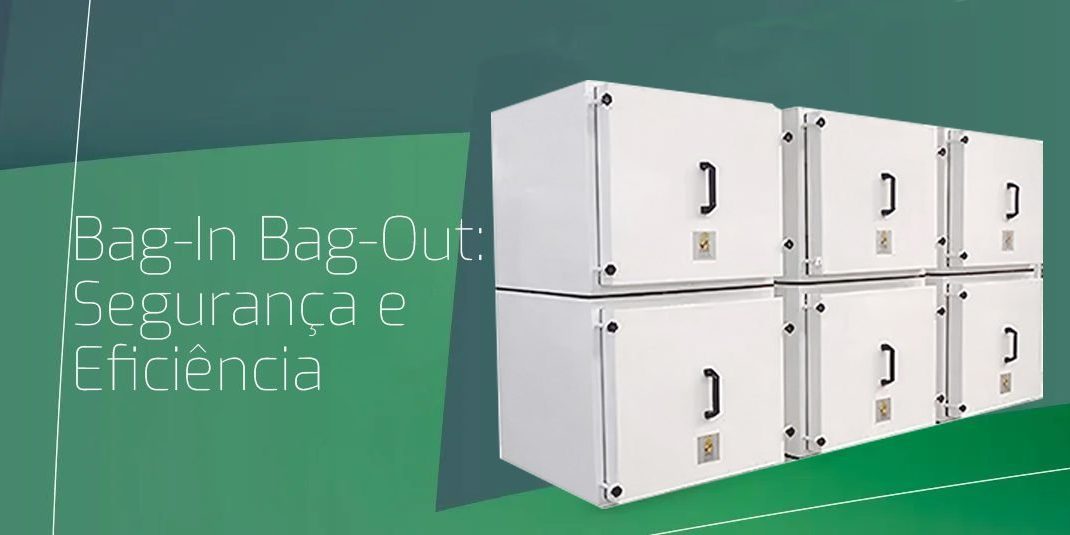
The materials used in the construction are also noteworthy. The structure is made of galvanized steel with high-resistance white epoxy paint or AISI 304 stainless steel with a sanitary or natural finish, which guarantees durability and meets the standards required in critical environments.
Furthermore, the system features absolute HEPA filters of class H14, in accordance with EN 1822, offering a minimum efficiency of 99,99% in retaining particles with diameters equal to or greater than 0,3 micrometers, an essential detail to guarantee maximum safety.
It is worth mentioning that the Bag-In Bag-Out has a modular and compact design. It can also be configured with more than one filtration stage, depending on the application. This makes the system versatile and adaptable.
System advantages
The Bag-In Bag-Out system offers several advantages. The main one is safety. It protects operators from direct contact with contaminants during maintenance, drastically reducing occupational risks.
Another major advantage is operational efficiency. Since Bag-In Bag-Out was developed with critical situations in mind, it makes maintenance faster and more organized, without compromising safety. This means less time with the system down and less chance of human error during changeovers, something essential in places where continuity of operation is vital.
Furthermore, the system complies with international safety and quality standards, which provides greater peace of mind for companies that need to follow strict regulations. The modular and compact design also contributes to its versatility, as it allows adaptations to different air volumes and types of application, without losing efficiency.
Conclusion
Bag -In Bag-Out represents a commitment to safety, efficiency, and environmental preservation. In environments where the air may contain hazardous contaminants, ensuring that maintenance is carried out safely is not just a technical matter, but an essential responsibility.
With its well-designed features, such as double sealing, sealed filters and high-strength materials, Bag-In Bag-Out can meet the demands of several critical sectors, such as hospitals, laboratories and chemical and pharmaceutical industries. It offers protection not only during operation, but also at the most delicate moment: filter replacement.
Interested in learning more? Contact us at Asmontec, we're ready to assist you.