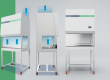
At Asmontec, we understand that safety is one of the fundamental pillars in any laboratory environment. Therefore, it is essential to have reliable equipment, designed to protect the operator, the product and the surrounding environment. We know that the biological safety cabinet is one of these pieces of equipment, especially in activities involving pathogens, toxic substances or processes that require strict contamination control.
Biological safety cabinets are widely used in research laboratories, quality control, pharmaceutical and food industries, and also in healthcare areas. They act as physical and filtering barriers, ensuring that contaminated air does not circulate into the external environment and that the professional is protected when handling sensitive materials.
Throughout this article, we will explain what a biological safety cabinet is, how it works, what its main types are, and in which situations each model should be used. Our goal is to help you better understand the importance of this equipment and how it can contribute to the safety and efficiency of your operations.
You will find
What is a Biological Safety Cabinet for?
The main function of the biological safety cabinet is to provide a controlled environment for handling substances with biological risk. It is designed to protect three important elements during work: the operator, the product and the environment.
In the day-to-day running of a laboratory or production line, it is common to deal with microbiological agents, contaminating particles and chemical substances that can pose risks to health and the integrity of samples.
The cabin acts as a physical and filtering barrier, preventing contaminated air from escaping into the external environment and preventing the handled product from being affected by external agents.
Furthermore, the use of a biological safety cabinet considerably reduces the risk of exposure to pathogenic microorganisms, toxins and harmful vapors. This ensures not only the protection of the professional, but also the reliability of the processes carried out and the final quality of the products analyzed or developed.
Therefore, this equipment is essential in sectors that require a high level of control, such as microbiology laboratories, pharmaceutical industries, hospital units, research centers and food production.
How does a Biological Safety Cabinet work?
The operation of a biological safety cabinet is based on strict control of air flow and efficient filtration of contaminant particles. The aim is to create a safe environment for both the operator and the material being handled and the surrounding space.
These cabins use a ventilation system that directs air through HEPA (High Efficiency Particulate Air) filters. These filters are highly
efficient in retaining microscopic particles, including bacteria, viruses and aerosols, with a minimum efficiency of 99,97% for particles up to 0,3
micrometers.
The air inside the cabin can be partially recirculated and partially exhausted, depending on the equipment class. In Class II A1 and A2 models, for example, around 70% of the air is recirculated inside the cabin itself, passing through the HEPA filters again, while 30% is safely exhausted. In Class II B2, 100% of the air is exhausted to the outside environment, without recirculation, through a system of ducts and exhaust fans, ideal for handling toxic and volatile substances.
Furthermore, the airflow is carefully controlled to prevent the formation of turbulence or backdrafts that could compromise containment. This ensures that contaminated air is continuously filtered and that the work area remains free of unwanted particles. This combination of advanced filtration and targeted airflow is what makes the biological safety cabinet such a reliable and efficient solution for protecting against biological hazards.
Main types of Biological Safety Cabinet
Class II biological safety cabinets are the most commonly used in laboratories and controlled environments, as they offer protection to the operator, the product and the external environment.
Within this classification, there are different models that vary according to the level of risk of the materials handled and the type of air exhaust. Below, we explain the differences between the main types: Class II A1, A2 and B2.
Class II A1
The Class II A1 cabinet is suitable for handling substances with low to moderate biological risk, common in routine laboratory processes and quality control. In this model, approximately 70% of the air is recirculated inside the cabinet through HEPA filters, and the remaining 30% is exhausted to the internal environment of the laboratory, also filtered.
Main Features:
- Recirculation of 70% of filtered air;
- 30% air exhaust with absolute filter (HEPA);
- Indicated for biological agents of known risk and low toxicity.
This model is ideal for activities such as sample preparation, cell culture manipulation and simple microbiological tests, without the presence of toxic or volatile chemicals.
Class II A2
The Class II A2 cabin has the same principle of 70% recirculation and 30% exhaust, but with an important difference: the exhausted air is directed to the external environment through a duct and a remote extractor, also passing through a HEPA filter.
Main Features:
- 70% air recirculation;
- 30% external exhaust by system with remote extractor;
- Greater safety for handling products with a slight presence of volatiles or radioisotopes.
This model is recommended for situations that require an additional level of containment, such as the use of small amounts of volatile or radioactive chemicals in conjunction with biological materials.
Class II B2
The Class II B2 cabin is the safest of the Class II options, and is designed for work with highly toxic, volatile or radioactive substances. Unlike the previous ones, it does not have recirculation: 100% of the air is exhausted to the outside environment through a duct system and a remote extractor with HEPA filter.
Main Features:
- 100% of the air is exhausted, without recirculation;
- Exhaust system connected to a remote extractor;
- Suitable for handling harmful chemical substances, radioisotopes and high-risk biological agents.
This model is essential in procedures with high potential for contamination or toxicity, ensuring maximum safety for the operator and the environment.
Technical characteristics of the equipment
Biological safety cabinets are designed to meet the highest standards of quality, durability and protection. At Asmontec, every technical detail is designed to ensure safety, comfort and efficiency during use.
Materials used in construction
The cabin structure is built with resistant and easy-to-clean materials, essential for environments that require strict microbiological control. The models can be manufactured in:
- Galvanized steel with electrostatic paint in white, which offers high durability and corrosion resistance;
- AISI 304 stainless steel with sanitary standard finish, ideal for environments that require maximum cleanliness and asepsis;
- Work table in AISI 304 stainless steel, with a smooth and sanitary finish, resistant to chemicals and easy to clean.
These materials contribute to the longevity of the equipment and reduce the risk of cross-contamination.
Safety and comfort items
In addition to the robust structure, the cabins have several features aimed at operator safety and practicality in everyday life:
- 6mm tempered glass front window, with tilting, guillotine or automated opening, which guarantees protection and visibility;
- Side windows also in 6 mm tempered glass, allowing natural lighting and external monitoring of activity;
- LED lighting in the work area, offering better visibility and low energy consumption;
- Germicidal (UV) lamp, which disinfects the interior of the cabin when it is not in use;
- Auxiliary socket, which facilitates the connection of equipment used inside the cabin;
- Noise level below 55 dB(A), providing a more comfortable and quiet working environment.
These features make the equipment not only safe, but also functional and ergonomic, contributing to the productivity of professionals and the efficiency of laboratory processes.
You can find more details in another article here on our blog. Click here.
The importance of proper choice
The biological safety cabinet is an essential piece of equipment in environments that deal with biological agents, chemical substances or processes that require strict contamination control. Choosing the correct class of cabinet – whether A1, A2 or B2 – is essential to ensure operator safety, product integrity and protection of the work environment.
Each type of application demands specific requirements, which is why it is essential to have the support of qualified professionals to assess technical needs and guide you towards the best choice.
If you are looking for quality, safety and efficiency, Asmontec is ready to help. Contact us and have all your questions answered by our specialized technical team. We are available to offer customized solutions for your project.
Talk to Asmontec right now and request personalized technical assistance.