In March 2020, shortly after the confirmation of the first case of infection with the new coronavirus in Brazil, the World Health Organization (WHO) declared the COVID-19 pandemic. The disease that is easily transmitted through the air, can also be transmitted by surfaces and therefore requires protective measures.
Naturally, healthcare facilities, because they receive people suspected of or diagnosed with the disease, must take care of biosecurity in their environments, which includes the use of Personal Protective Equipment, collective protective equipment, and other items, such as appropriate hospital doors, which are essential in preserving controlled environments.
Thus, doctors, nurses, other professionals and patients enjoy greater security in rooms where there is possibly a greater potential for contamination by infectious diseases.
The choice of hospital doors should follow some guidelines. We comment on these rules in this article, in which you will also understand the importance of these products in preserving health and learn about some options offered by Asmontec.
You will find
Regulatory Norms for Hospitals
The Ministry of Health, in order to promote better working conditions for professionals in the area, has several regulatory standards that prevent accidents, promote well-being and even reduce costs, such as the following:
- NR-07: discusses the elaboration and implementation of the Occupational Health Medical Control Program;
- NR-09: comments on the evaluation and control of occupational exposures to chemical, physical and biological agents;
- NR-15: lists unhealthy activities, which involve biological agents;
- NR-23: discipline on fire protection measures in work environments; and
- NR 32: establishes the basic guidelines for the implementation of measures to protect the safety and health of health service workers and people who carry out health promotion and assistance activities in general.
With regard to hospital doors, there are rules on minimum width, opening direction and the mandatory use of a locking system in radiotherapy services.
It is important to emphasize that, in addition to taking care of people's health, respecting the rules is a decision that is beneficial to the finances of a hospital, because, in this way, expenses with maintenance and indemnities are avoided.
Collegiate Board Resolution No. 50 of the National Health Surveillance Agency (ANVISA) also deals with hospital doors.
The document, which guides construction, renovations and installations of health care establishments, establishes the use of “opening” and never “sliding” or revolving doors, minimum dimensions and the use of lever-type door handles.
And, to combat infectious agents, when the level of biosecurity requires, the use of double access doors with automatic closing.
Importance of hospital doors
Installing appropriate hospital doors is an essential measure for building cleanrooms in hospitals and also controlled environments. These environments, which must have low levels of pollutants, help prevent contamination by microorganisms present in the air.
Thus, hospital doors, like the air filtration system , help ensure a safe environment and prevent the spread of disease. It's no coincidence that Intensive Care Units (ICUs) also have anterooms separated by this product.
The use of hospital doors is even more evident in times of epidemics or pandemics, due to the potential for disease transmission and the difficulty of health systems to deal with all cases.
One of the ways that the virus that causes COVID-19 infects people is through the air and hospital environments are therefore more sensitive due to the production of aerosols. This means that, in these places, the concern with air filtration, ventilation and other measures is even more noticeable.
This shows that isolation is essential and that hospital doors play a fundamental role in containing and preventing contamination by microorganisms, whether via contact with the skin, mucous membranes, droplets or aerosol.
This usefulness naturally extends to temporary or permanent hospitals , which receive many sick patients and must prevent the proliferation of microorganisms and thus combat the disease in question.
Various models of hospital doors
Choosing a quality door, which works correctly and complies with the standards and needs of the project, is a very important measure of health care for employees and patients, especially in a pandemic scenario.
Asmontec offers technologically advanced models ideal for use in hospital cleanrooms. Our catalog includes doors with aluminum or AISI 304 stainless steel frames , single and double tempered glass or polycarbonate windows, and EPS (Expanded Polystyrene), PUR (Polyurethane), and LDR (Rock Wool) cores. Check out some of our door models:
Simple Doors

Simple doors have an aluminum or stainless steel frame, with click-fit panels made of galvanized or stainless steel sheet, single or double silicone sealing gaskets, and rock wool insulation.
Double Doors
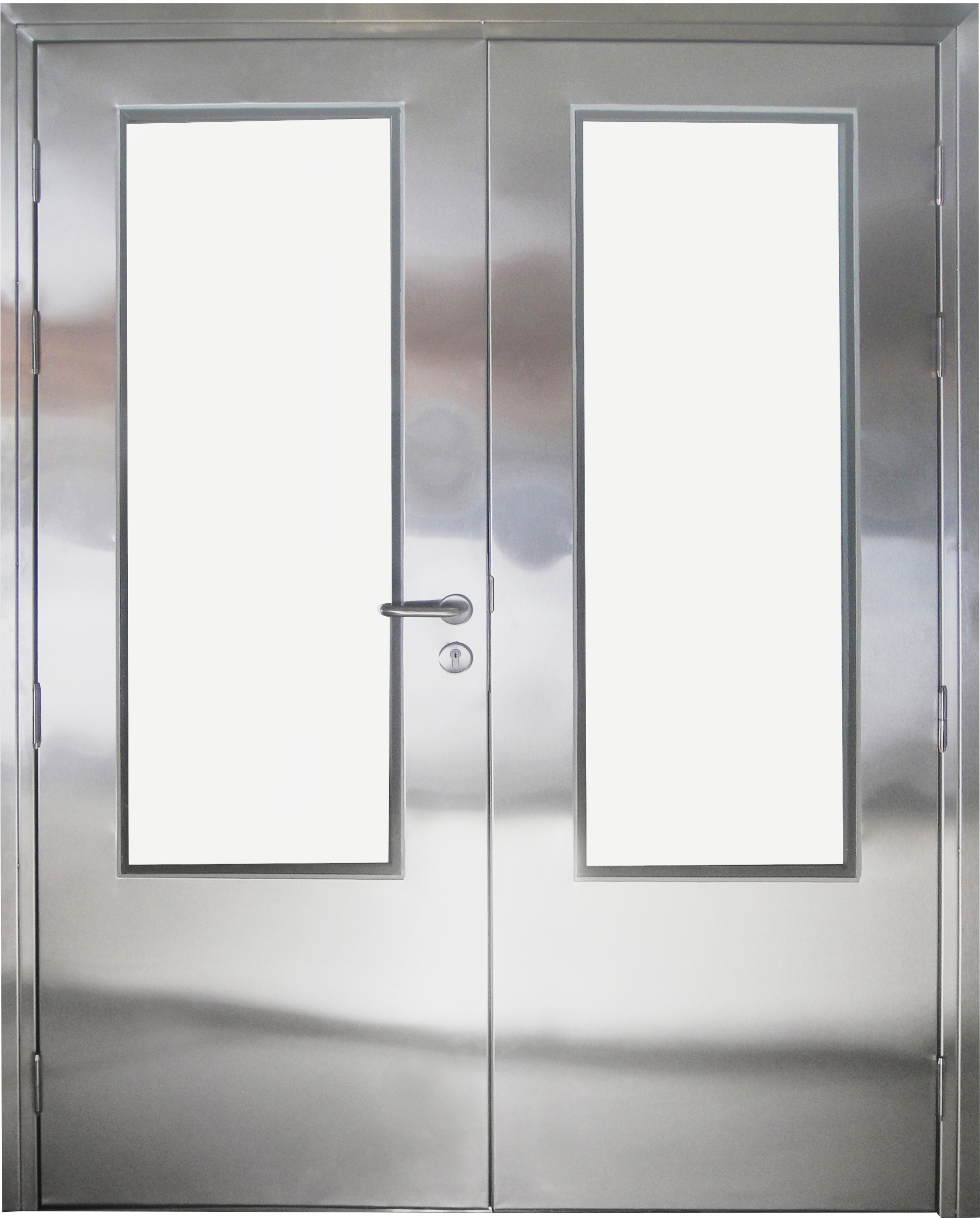
Double doors have the same properties as single doors; their distinguishing feature is the two doors, allowing for the passage of larger objects, such as stretchers and mobile beds.
Sliding doors

The sliding door has an aluminum or stainless steel frame, click-in panels made of galvanized or stainless steel sheet, with a double silicone sealing gasket, ensuring greater protection for the environment.
Recommendations and precautions for your project.
Following Anvisa's recommendations, mentioned earlier in this article, at Asmontec, the customer also finds double hospital doors, with aluminum or stainless steel lever handle, seal and lock with a mastering option, that is, with access control.
The doors can be installed in partitions, masonry, and drywall, ensuring adaptability to specific projects.
Asmontec's customer can still choose accessories to compose the hospital doors of their projects, such as anti-panic bars, springs, access control and biometrics and the company meets the needs of the project to the implementation.
Furthermore, Asmontec recently planned and built a permanent hospital in Rio de Janeiro , in conjunction with Fiocruz. The project included more than 100 ICU beds, 100 semi-intensive care units, and the installation of sealed doors to treat COVID-19 patients, following established norms and standards.
Hospital doors, in short, are essential in health facilities because they contain and prevent the proliferation of microorganisms and, thus, ensure greater safety for people. The Ministry of Health and Anvisa establish some standards in this regard and, for hospital environments, recommend the use of “opening” doors with lever-type handles and dimensions that vary according to the installation location. In any case, however, the objective is to facilitate the passage of people and equipment and preserve the health of everyone. Models like these you can find at Asmotec.
If you need doors for a new healthcare facility, renovation, or expansion, contact us . Asmontec has over 30 years of experience and can assist you from planning to installation.