For a cleanroom to meet all the requirements of the activities that will be carried out in it, it needs to be very well designed and developed. Therefore, all care must be taken, from the design to the acquisition of cleanroom products. After all, the materials used must be specially designed for a controlled environment. After all, the equipment needs to be agents of protection and not of contamination of the environment.
The main contaminants in environments are:
- particles;
- Microorganism-carrying particles;
- Chemical substances;
- Electrostatic Charges.
Cleanroom products
In general, furniture needed for a cleanroom should be made of electropolished stainless steel ( learn more about stainless steel for cleanrooms ), powder-coated, or solid plastic.
Therefore, in the cleanroom design phase, they must be very well selected and chosen according to the flow of people in that environment and, also, it must be thought exactly about the activities that will be developed within that controlled environment.
And that's precisely why the planning and design phase is one of the most important steps when considering the construction of a cleanroom. To learn more about the subject and avoid mistakes when designing your cleanroom, simply read the content: " Cleanroom Design: 7 tips to start yours successfully ".
Well, after establishing well-defined parameters in the process of designing your clean room, now it's time to choose the best equipment for the activities that will be carried out within the clean room.
Get to know the main and fundamental equipment for the proper functioning of your clean room.
panels and dividers
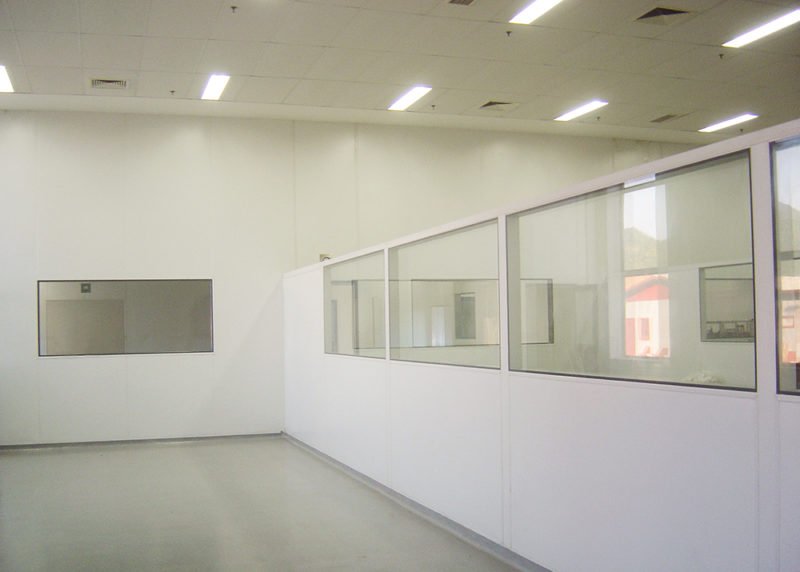
They function like walls inside a clean room. They are produced and installed, always taking into account the entire environment configuration, including pipes and electrodes.
It is also essential that they have acoustic insulation with a core that can be made of different materials. The equipment's coverings must be developed in pre-painted steel sheets or stainless steel, with a male/female, click or special fitting system.
Furthermore, it is important that the panels and partitions have rounded corners and that their surface is completely smooth and impermeable. After all, this prevents the release of particles and facilitates cleaning the environment. Thus, the equipment fulfills its main objective, which is to control environmental contamination.
Find the best panels and partitions for your cleanroom project.
Another very interesting purpose of cleanroom partitions is the fact that they provide greater visibility between all areas of the process. In these cases, they are produced in tempered or laminated glass, polycarbonate or acrylic.
They are installed in a structure with white aluminum or stainless steel tubes. The finish can be slanted, thus contributing to cleanliness.
Rounded corners in a clean room

The finishes, in a clean room, are used especially in enclosures, such as: wall/floor, wall/ceiling, wall/wall, among others. Rounded corners provide the following cleanroom advantages:
- Facilitate air recirculation;
- Assist in the process of sealing the cleanroom complex;
- In addition to not generating particles, they also do not retain;
- They do not allow the proliferation of bacteria;
- They are resistant to oxidation from cleaning agents as well as impact.
Lights for clean rooms

In terms of lighting in clean rooms, it is important to follow the standards and guidelines already established by the GMP. They must be produced in materials and formats that facilitate cleaning.
They must also be resistant to pressurization of clean room air, temperature and humidity conditions. They have a XNUMX-millimeter tempered glass lid, carry fluorescent or LED lamps, in addition to having an aluminum deflector.
See which light fixtures best fit your project: light fixtures for clean rooms.
Pass through to clean rooms

Essential for the proper functioning of a cleanroom, a pass-through is a box-shaped piece of equipment used to transfer materials from one part of the production process to another.
The equipment is primarily installed with the main objective of avoiding the so-called “cross-contamination”. That is, it prevents a product from carrying contamination from one part of the process to the other.
They can be designed with custom dimensions, according to the needs of the environment. They can also contain accessories such as UV lamps, air supply, return, among others.
Check the types of pass through available:
- Painted steel;
- Stainless steel;
- Active pass through;
- Special;
- With exhaust duct;
- With filtration system;
- With inflation;
- With UV lamp;
- Guillotine door.
Click here to see all types of pass-throughs and which one best suits your project.
clean room doors

There are several models of doors for a clean room, so to choose the right one, you need to evaluate what your main goals in the project are. But how to evaluate this? Just know what your clean room needs will be: analyze whether people, heavy materials, large, small, etc. will pass through that space.
Your conclusion regarding this scenario will determine which port type is best for your controlled environment. It must be installed in the environment in partitions, masonry or dry-wall, with the development of special stops for each type of need.
Like panels and partitions, cleanroom doors have a core in EPS, PUR, PIR or LDR. The doors are available in different types: with stainless steel hinges, retractable or adjustable lower seal, aluminum and stainless steel handle and lock with an option for mastering.
They can even be made of aluminum or stainless steel, have single or double visors and can receive accessories. Among the most common are panic bars, springs, access controls and biometrics.
Viewfinders for clean rooms
Viewfinders for a cleanroom also contribute to increasing visibility between parts of the production process. They are usually made of tempered or laminated glass, in addition to polycarbonate and acrylic, as well as the partitions.
They can have an internal frame in aluminum or stainless steel, silica gel at the bottom, nitrogen injection and closure with silicone. The installation of the windows is done in partitions, masonry and dry-wall.
Clean room accessories

To complete the project and meet the various needs of a cleanroom, there is a variety of accessories ranging from tubular protectors, shafts, and furniture, to more specific items such as tank and air-shower enclosures, and auxiliary structures to support special partitions.
Each product and piece of equipment shown above contributes to the excellent functioning of a cleanroom , according to the needs and activities that will be performed within the controlled environment. And to learn more about what a cleanroom is, its functions, standards and classifications, simply click here.
For a clean room to meet all the requirements of the activities that will be developed in it, it must be very well designed and developed. Therefore, all care must be tripled. After all, the materials used must be specially designed for a controlled environment. Therefore, the equipment needs to be agents of protection and not of contamination of the environment.
The main contaminants in environments are:
- particles;
- Microorganism-carrying particles;
- Chemical substances;
- Electrostatic Charges.
Products for a clean room
In general, furniture needed for a cleanroom should be made of electropolished stainless steel ( learn more about stainless steel for cleanrooms ), powder-coated, or solid plastic.
Therefore, in the cleanroom design phase, they must be very well selected and chosen according to the flow of people in that environment and, also, it must be thought exactly about the activities that will be developed within that controlled environment.
And that's precisely why the planning and design phase is one of the most important steps when considering the construction of a cleanroom. To learn more about the subject and avoid mistakes when designing your cleanroom, simply read the content: " Cleanroom Design: 7 tips to start yours successfully ".
Well, after establishing well-defined parameters in the process of designing your clean room, now it's time to choose the best equipment for the activities that will be carried out within the clean room.
Get to know the main and fundamental equipment for the proper functioning of your clean room.
panels and dividers
They function like walls inside a clean room. They are produced and installed, always taking into account the entire environment configuration, including pipes and electrodes.
It is also essential that they have acoustic insulation with a core that can be made of different materials. The equipment's coverings must be developed in pre-painted steel sheets or stainless steel, with a male/female, click or special fitting system.
Furthermore, it is important that the panels and partitions have rounded corners and that their surface is completely smooth and impermeable. After all, this prevents the release of particles and facilitates cleaning the environment. Thus, the equipment fulfills its main objective, which is to control environmental contamination.
Another very interesting purpose of cleanroom partitions is the fact that they provide greater visibility between all areas of the process. In these cases, they are produced in tempered or laminated glass, polycarbonate or acrylic.
They are installed in a structure with white aluminum or stainless steel tubes. The finish can be slanted, thus contributing to cleanliness.
Rounded corners in a clean room
The finishes, in a clean room, are used especially in enclosures, such as: wall/floor, wall/ceiling, wall/wall, among others. Rounded corners provide the following cleanroom advantages:
- Facilitate air recirculation;
- Assist in the process of sealing the cleanroom complex;
- In addition to not generating particles, they also do not retain;
- They do not allow the proliferation of bacteria;
- They are resistant to oxidation from cleaning agents as well as impact.
Lights for clean rooms
In terms of lighting in clean rooms, it is important to follow the standards and guidelines already established by the GMP. They must be produced in materials and formats that facilitate cleaning.
They must also be resistant to pressurization of clean room air, temperature and humidity conditions. They have a XNUMX-millimeter tempered glass lid, carry fluorescent or LED lamps, in addition to having an aluminum deflector.
See which light fixtures best fit your project: light fixtures for clean rooms.
Pass through to clean rooms
Essential for the proper functioning of a cleanroom, a pass-through is a box-shaped piece of equipment used to transfer materials from one part of the production process to another.
The equipment is primarily installed with the main objective of avoiding the so-called “cross-contamination”. That is, it prevents a product from carrying contamination from one part of the process to the other.
They can be designed with custom dimensions, according to the needs of the environment. They can also contain accessories such as UV lamps, air supply, return, among others.
Check the types of pass through available:
- Painted steel;
- Stainless steel;
- Active pass through;
- Special;
- With exhaust duct;
- With filtration system;
- With inflation;
- With UV lamp;
- Guillotine door.
Click here to see all types of pass-throughs and which one best suits your project.
clean room doors
There are several models of doors for a clean room, so to choose the right one, you need to evaluate what your main goals in the project are. But how to evaluate this? Just know what your clean room needs will be: analyze whether people, heavy materials, large, small, etc. will pass through that space.
Your conclusion regarding this scenario will determine which port type is best for your controlled environment. It must be installed in the environment in partitions, masonry or dry-wall, with the development of special stops for each type of need.
Like panels and partitions, cleanroom doors have a core in EPS, PUR, PIR or LDR. The doors are available in different types: with stainless steel hinges, retractable or adjustable lower seal, aluminum and stainless steel handle and lock with an option for mastering.
They can even be made of aluminum or stainless steel, have single or double visors and can receive accessories. Among the most common are panic bars, springs, access controls and biometrics.
Viewfinders for clean rooms
Viewfinders for a cleanroom also contribute to increasing visibility between parts of the production process. They are usually made of tempered or laminated glass, in addition to polycarbonate and acrylic, as well as the partitions.
They can have an internal frame in aluminum or stainless steel, silica gel at the bottom, nitrogen injection and closure with silicone. The installation of the windows is done in partitions, masonry and dry-wall.
Clean room accessories
To complete the project and meet the various needs of a cleanroom, there is a variety of accessories ranging from tubular protectors, shafts, and furniture, to more specific items such as tank and air-shower enclosures, and auxiliary structures to support special partitions.
Each product and piece of equipment shown above contributes to the excellent functioning of a cleanroom , according to the needs and activities that will be carried out within the controlled environment. And to learn more about what a cleanroom is, its functions, standards and classifications, simply click here.