
The Modular Panel is a prefabricated, sandwich-style construction system that offers a smooth, non-particulate finish, speed of assembly, and layout flexibility that masonry can never provide. It is essential for meeting the stringent biosafety and air purity classification requirements imposed by standards such as ISO 14644 and ANVISA's RDC 301.
Table of contents
- The Evolution of Engineering: From Brick to Modularity
- What is a modular panel in practice for cleanrooms?
- Types and Classifications of Modular Panels
- The advantages of modular panels in cleanroom construction.
- Standards and compliance of modular panels
- Modular Panel vs. Conventional Masonry
- You may also like
- Frequently Asked Questions about Modular Panels
The Evolution of Engineering: From Brick to Modularity
In our field, controlled environment engineering, we know that infrastructure is just as critical as the process it houses. Think of pharmaceutical industries, hospitals, or biotechnology laboratories: the smallest particle can compromise an entire batch, a research result, or, worse, the health of patients.
The traditional construction method, the old masonry, has become an unavoidable bottleneck. It's slow, generates an absurd amount of dust and debris on the construction site, and, let's be honest, maintaining the sanitary conditions of its porous surfaces is a nightmare.
This is why the construction of modern Cleanrooms requires a different approach: industrialized and clean. This is where the Modular panel comes in, not as a simple wall replacement, but as the technological platform for contamination control.
What is a modular panel in practice for cleanrooms?
Leaving the jargon aside, the Modular Panel is what I call a "smart wall". Its essence is to be a 'sandwich' structure, where a high-performance insulating material (the core) is pressed and sealed by two cladding sheets.
The magic, however, lies in the modularity and prefabrication. The system is entirely designed and manufactured in our plant, with minimal tolerances and a guaranteed finish.
The crucial detail for controlled environments is their sanitary finish. The surfaces are smooth, non-porous, and the fitting and sealing system is designed to eliminate sharp corners and crevices that become a haven for bacteria and the accumulation of particles.
Types and Classifications of Modular Panels
The choice of the ideal modular panel depends directly on its function and the inherent risks of the environment it will surround. The key differentiating element between panels is the material used in their core, which provides specific insulation and resistance characteristics.
Panels with a Polyurethane (PU) or Polyisocyanurate (PIR) core
Injected polyurethane is one of the most widely used materials due to its excellent cost-benefit ratio in thermal insulation. PU and, more recently, PIR (Polyisocyanurate, with improved fire behavior) guarantee a low heat transfer coefficient, crucial for the energy efficiency of HVAC systems in Cleanrooms, where temperature and humidity control is constant and rigorous. They are ideal for cold rooms and processing areas that require thermal stability.
Panels with Rock Wool or Glass Wool Core
For environments that handle flammable materials or require greater fire safety, panels with a rock wool or glass wool core are the best choice. Rock wool, in particular, is a non-combustible material that offers very high fire resistance, acting as a barrier that delays the spread of flames, protecting lives and equipment. In addition, both materials offer superior acoustic insulation performance, essential for operational comfort in environments with many operating devices (e.g., air conditioning systems, exhaust fans).
Stainless Steel Panels (AISI 304/316)
Stainless steel is the standard material for areas requiring the highest degree of sanitization or exposed to aggressive chemical agents. The modular panel with AISI 304 or 316 stainless steel coating is corrosion-resistant and allows the use of powerful disinfectants and sanitizers without compromising surface integrity. They are indispensable in sterile handling rooms, animal facilities, and areas requiring deep and frequent cleaning.
Superior Finishes
The surface coating is equally vital. Most panels use galvanized steel sheets with electrostatic epoxy or polyester paint. The finish must be smooth, non-porous, and scratch-resistant, ensuring that there is no shedding (release of particles) into the environment.
The advantages of modular panels in cleanroom construction.
Adopting modular panels goes beyond simply choosing a material; it's a strategic decision that impacts project management and long-term operational costs.
Speed and Schedule Optimization
Prefabrication and clean assembly reduce construction time by up to 50% compared to traditional construction. This means the company can get its production up and running faster, shortening time-to-market and generating revenue sooner.
Flexibility and Adaptability
Modularity allows the structure to be easily modified. If there is a need to move a wall, install a new display, or even disassemble the Clean Room for relocation, the modular panel allows this with minimal waste and disruption.
Excellence in Hygiene and Sanitary Control
Flat, non-porous surfaces and the absence of sharp corners are key to easy cleaning and validation. The Modular Panel is designed to prevent accumulation points for microorganisms and particles.
Standards and compliance of modular panels
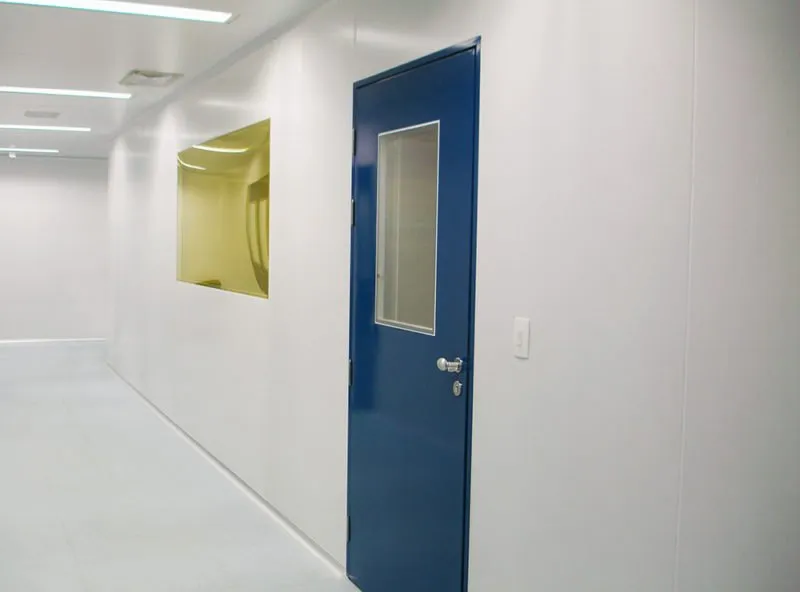
In our work as engineers, compliance with standards is non-negotiable. Choosing modular panels simplifies compliance with the most important industry regulations.
The most important of these is ISO 14644 , which classifies cleanrooms based on the concentration of airborne particles. To achieve the strictest classifications (ISO Class 5, for example), the infrastructure needs to be non-particulate, something that masonry can hardly achieve. The finish of modular panels is inherently compatible with these requirements.
In Brazil, ANVISA's Collegiate Board Resolution (RDC) No. 301 , which deals with Good Manufacturing Practices (GMP), clearly requires that the walls, floors, and ceilings of pharmaceutical and related production environments be smooth, impermeable, and easy to clean and disinfect. The Modular Panel is the literal embodiment of this regulatory requirement.
Modular Panel vs. Conventional Masonry
Although masonry may have a slightly lower initial cost per square meter in some cases, it fails miserably in the Total Cost of Ownership analysis. Modular panels win in the long run due to their inherent efficiency and conformity.
| Analysis Criteria | Conventional Masonry | Modular Panel |
| Particle Generation in Construction | High (Dust, Cement, Plaster) | Low (Clean Mount) |
| Runtime | Slow (Curing, Drying, Finishing) | Quick (Snap-fit assembly) |
| Flexibility for Changes | Null (Demolition and Reconstruction) | High (Disassembly and Reassembly) |
| Sanitary Compliance | Requires complex coatings. | Intrinsic (Smooth surface) |
| Thermal insulation | Additional materials are needed. | Integrated into the core (PU/PIR) |
Choosing a modular panel is therefore choosing efficiency, regulatory compliance, and operational agility.
Building the Future with Modular Panels

Technological advancement demands that infrastructure keep pace with innovation. The Modular Cleanroom Panel is modern engineering's answer to the stringent requirements of contamination control. It delivers speed of implementation, unparalleled flexibility, and the assurance of an environment that meets the strictest standards, such as ISO 14644 and ANVISA's RDC 301.
At Asmontec, we don't just supply the panel; we act as technical consultants, from the initial design to the final environmental qualification, ensuring that the choice of core and cladding is perfectly aligned with the critical needs of your production process. If your company seeks to solve contamination problems, optimize deadlines, and invest in a durable and flexible solution, the Modular Panel is the foundation.
You may also like
Frequently Asked Questions about Modular Panels
With proper maintenance, a high-quality modular panel , such as those made of galvanized steel with epoxy paint, has a lifespan comparable to or exceeding that of masonry, often surpassing 20 years, without the porosity or cracking problems that masonry presents. The durability of the sanitary cladding is a key advantage.
Yes, this is one of its greatest advantages. The modular structure was designed to be completely disassemblable and reassemblable, allowing the Clean Room to be relocated or adapted to new layouts with minimal material loss and high speed of execution, a key concept of flexibility in engineering.
Although the initial cost of Modular Panels per square meter may be marginally higher than simple masonry, the Total Cost of Ownership (TCO) tends to be lower. This is due to the speed of construction (which reduces labor costs and accelerates the start of operations) and the greater energy efficiency and lower maintenance costs of sanitary surfaces.
Yes. Using panels with a rock wool or glass wool core, the modular system can meet high fire resistance requirements, with reports and classifications that guarantee compliance with Brazilian (e.g., Fire Department IT) and international safety standards.