If your company deals with sensitive products, whether in the manufacture of medicines, food or medical devices, you know that this invisible risk is a constant threat to the quality, safety and, consequently, the profitability of your business.
Negligence or the application of inadequate solutions in the control of microorganisms can have catastrophic consequences. In this article, we will delve into the real impacts of microbiological contamination, understand where it comes from, and, most importantly, present engineering solutions that transform this risk into a guarantee of productive excellence.
If your company deals with sensitive products, whether in the manufacture of medicines, food or medical devices, you know that this invisible risk is a constant threat to the quality, safety and, consequently, the profitability of your business.
Negligence or the application of inadequate solutions in the control of microorganisms can have catastrophic consequences. In this article, we will delve into the real impacts of microbiological contamination, understand where it comes from, and, most importantly, present engineering solutions that transform this risk into a guarantee of productive excellence.
You will find
The invisible enemy of quality and the cost of negligence.
The relentless pursuit of quality and safety defines industrial excellence. However, there is an omnipresent and often invisible enemy: microorganisms. Microbiological contamination occurs when bacteria, fungi, yeasts, or viruses are introduced into a controlled environment, compromising the purity of a product or process.
The goal of any controlled environment, such as a cleanroom, is to mitigate the presence and proliferation of these agents. When this control fails, the result is not just a small problem; it's a chain of failures that affects everything from the production line to consumer confidence.
The Nature of Microbiological Contamination: Where Do the Risks Come From?
To fight an enemy, you must know him. Microbiological Contamination In productive environments, risk rarely has a single source. In fact, it is the result of the complex interaction of several risk factors.
The Personnel (The Biggest Risk Factor): Humans are by far the main source of contamination. Skin, hair, shed cells, droplets of saliva, and even ordinary clothing carry millions of microorganisms. Therefore, rigorous personal protective equipment and access protocols (such as the use of...) are essential. Pass-Throughs and antechambers) are the first and most crucial barrier.
Air and the HVAC System: Air itself, if not properly treated, is a vehicle for transporting particles that carry microorganisms. Inefficient filtration or poorly designed airflow allows contaminants to settle on critical surfaces.
Surfaces and Equipment: Any unsanitary surface, from countertops to production equipment, can become a biofilm, a breeding ground for colonies that disperse into the environment. Inadequate building materials or difficulty in cleaning accelerate this process.
Raw Materials and Supplies: Items entering the environment, such as packaging and raw materials, carry an inherent risk of introducing contaminants, highlighting the importance of unpacking chambers and rigorous transfer protocols.
The Four Pillars of Loss: Direct Impacts on Production
The costs of Microbiological Contamination They go far beyond simply disposing of the contaminated batch. They are established in four critical areas that directly affect the company's balance sheet and sustainability:
1. Loss of Batches and Disposal of Products
The most immediate impact is the loss of production. A contaminated batch must be entirely discarded. This is a direct loss that includes the cost of raw materials, labor time, and energy invested in the process. In high value-added industries, such as pharmaceuticals, the cost of a single batch can be millions of reais.
2. Financial Losses Due to Recalls and Downtime
The discovery of contamination in products that have already been distributed leads to the dreaded recallIn addition to the enormous logistical cost of collecting and destroying the product, there is a cost of downtime: the production line needs to be stopped for a thorough investigation and deep cleaning.deep cleaning).
3. Damage to Consumer Reputation and Trust
Trust in a brand is an invaluable asset. An event of Microbiological Contamination What reaches the public can destroy years of reputation. In sectors such as food and pharmaceuticals, where consumer safety is non-negotiable, this can result in a permanent loss of market share.
4. Regulatory Issues and Sanctions
Regulatory bodies, such as ANVISA in Brazil, demand the highest standards of Good Manufacturing Practices (GMP). Failures in microbiological control lead to warnings, heavy fines, production line shutdowns, and, in the most serious cases, suspension of the operating license.
“Controlling contamination is not a cost, but an indispensable investment for the viability of the business. A single GMP failure can undo years of success and jeopardize public health, proving that the quality of the final product is intrinsically linked to the purity of the manufacturing environment.”
Adapted from "Guide to Good Manufacturing Practices and Quality Control," referencing the philosophy of contamination control.
You can access the complete guide on the GOV portal.
The Standard of Excellence: Microbiological Control in Cleanrooms
The ultimate solution for Microbiological Contamination It resides in controlled environments — cleanrooms. These environments operate under strict principles that attack the sources of contamination at their origin.
Essential Standards and Regulations
For the pharmaceutical sector, the highest benchmark is... RDC nº 301/2019 of ANVISA, which adopts Good Manufacturing Practices of Pharmaceutical Inspection Co-operation Scheme (PIC/S).
In terms of air classification, the international standard ISO 14644 establishes the maximum number of particles allowed per cubic meter. For microbiological control, the most restrictive classes, such as... ISO Class 5 (formerly Class 100), require an extremely low number of viable microorganisms.
The Role of Positive Pressure
The operating principle is Positive Pressure. This means that the air inside the cleanroom is maintained at a pressure slightly higher than that of the surrounding environment. If there is a crack or opening, the air will escape. clean fluid out, preventing the air contaminated flow insideThis is a passive, but crucial, defense mechanism.
Asmontec Engineering Solutions: Shielding Your Process
As engineers, our focus is on transforming these concepts and standards into physical and functional solutions that shield your process against microbiological contamination. At Asmontec, we work with equipment designed for absolute control:
Absolute Air Filtration (HEPA/ULPA)
Filtration is the heart of particle control.
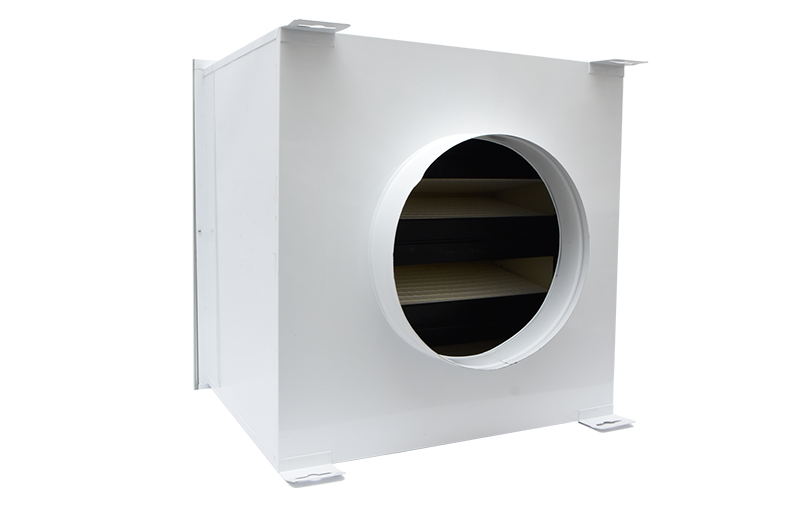
Terminal Boxes with Absolute Filter: Installed at the final air supply point, these boxes contain H14 class HEPA (High Efficiency Particulate Air) filters, guaranteeing the retention of 99,99% of particles from 0,3 µm. They ensure that the air entering the room is essentially free of contaminants.

Filtering Lining: It combines air diffusion with final filtration, generating an ultra-clean and uniform airflow, essential in Class A or B areas.
2. Access Control and Transfer (Pass-Through)
The moment of material transfer is a critical risk point.

PassThrough: It acts as a blocking chamber between different cleaning classes. By using interlock systems, the Pass Through It ensures that the door on the "dirty" side and the door on the "clean" side are never opened simultaneously, isolating the transfer process and mitigating the introduction of microorganisms through materials.
3. Solutions for Equipment and Environmental Cleaning
Even with clean air, residual contamination must be eliminated.
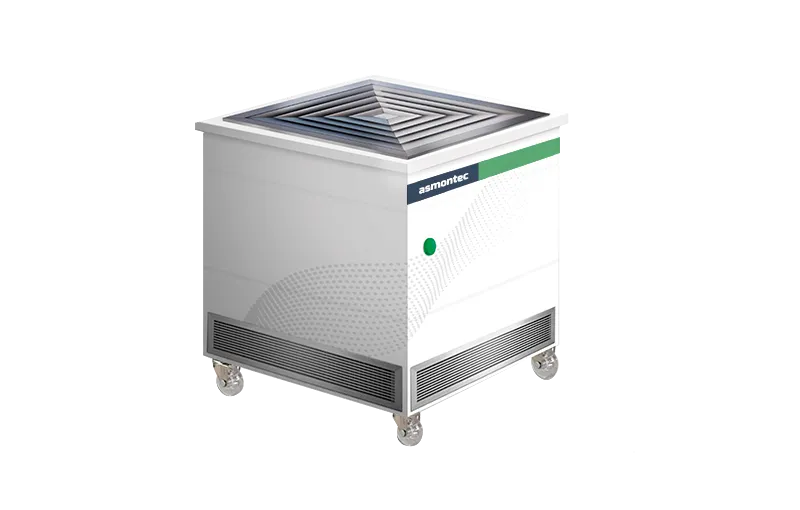
Air Purifier (Puriflow): For adjacent areas (such as offices or support areas) or as a booster in critical environments, the Air Purifier with HEPA filters and optionally UV germicidal lighting, recirculates and cleans the air, combating dispersed microorganisms efficiently and efficiently.
Investing in Control is Guaranteeing the Future of Your Brand
A Microbiological Contamination This is a threat that demands a robust engineering response. In a market where safety and compliance are crucial, investing in air control systems and physical barriers is not an expense, but rather the primary insurance policy for the quality and reputation of your brand.
We at Asmontec are here to act as your technical consultant, offering solutions that ensure the correct classification of your environment, following ISO 14644 standards and ANVISA guidelines.
If you are ready to transform the risk of Microbiological Contamination With a guarantee of purity and efficiency, our team of experts can assist you from design to installation.
Contact us and let's plan the best engineering solution to shield your production!
You may also like
Answers to the main questions about Microbiological Contamination
The main source is the personalThe human body releases millions of particles per minute. Therefore, rigorous protocols for donning personal protective equipment, training, and the use of access barriers (such as...) are essential. Pass-Throughs (in antechambers) are the most critical defense.
Positive Pressure does not eliminate contamination, but it is a fundamental mechanism of preventionIt prevents potentially contaminated air from less clean areas from entering the cleanroom, forcing the flow of clean air out in case of openings, such as doors and cracks. Elimination is done through filtration (HEPA/ULPA filters).
Brazilian Regulatory Decree No. 301/2019 (which deals with Good Manufacturing Practices) requires that production areas be classified and monitored to ensure that limits for viable particles and microorganisms are maintained, defining criteria for environmental monitoring and validation of air treatment systems.
No. An air purifier (like the Puriflow) is excellent for recirculating and purifying air in adjacent areas or as a spot booster. However, a dedicated cleanroom HVAC system is essential, as it not only filters but also controls differential pressure, temperature, and humidity—crucial requirements that a portable purifier cannot guarantee.