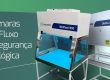
Clean and controlled environments demand a high level of attention to air quality, especially when the process involves sensitive or sterile products. It is in this scenario that unidirectional flow systems become fundamental.
These systems are designed to ensure that air flows in a single direction , at constant speed and pressure, creating a barrier against particles and impurities. They are widely used in the pharmaceutical industry, laboratories, research centers, cosmetics, and even in food production.
But did you know that there are different types of unidirectional flow systems, each with their own specific characteristics and applications?
In this article, I will present the main ones:
- ISO 5 Vertical Unidirectional Flow Chamber
- Horizontal Unidirectional Flow Chamber ISO 5
- ISO 5 Vertical Flow Passage/Sampling and Containment System
- Vertical Unidirectional Flow System ISO Class 5
I will show you what makes each of them different, where they are used and how they help maintain safety and quality in the most demanding processes.
You will find
- What characterizes a unidirectional flow system?
- ISO 5 Vertical Unidirectional Flow Chamber
- Horizontal Unidirectional Flow Chamber ISO 5
- ISO 5 Vertical Flow Passage/Sampling and Containment System
- Vertical Unidirectional Flow System ISO Class 5
- Conclusion: Choosing the right system makes all the difference
- Are you unsure about which system best fits your environment?
What characterizes a unidirectional flow system?
A unidirectional airflow system is designed to create a clean and continuous air environment , with movement always in the same direction , at a constant speed and in a controlled manner. The main objective is to avoid turbulence and reduce the presence of airborne particles , creating a work zone with the lowest possible level of contamination.
This type of system is common in areas classified as ISO 5 , where the particle count needs to be extremely low. To achieve this level of purity, the air passes through absolute filters (such as HEPA or ULPA filters), which remove up to 99,99% of particles measuring 0,3 micrometers or more.
Airflow can be directed in different ways, giving rise to the types of systems we will see below. But they all have something in common: ensuring that clean air passes through the critical area and expels contaminated air from the handling zone, creating a safe and controlled environment.
ISO 5 Vertical Unidirectional Flow Chamber
The ISO 5 vertical unidirectional airflow chamber is one of the most widely used systems in environments requiring high contamination control. In this model, air is filtered at the top of the chamber and descends vertically over the work area in laminar flow, pushing particles downwards and keeping the handling zone always protected.
How does it work?
Air from the outside environment is drawn into the chamber, passes through absolute filters (usually HEPA H14) installed in the ceiling of the unit, and is directed downwards in a constant manner. This vertical movement creates a barrier of clean air between the operator and the product, minimizing the risk of contaminants entering.
Main applications:
- Handling of active ingredients in pharmaceutical industries
- Weighing of powdered substances
- Sample preparation in laboratories
- Processes that require high purity of air over the product
Advantages:
- Direct protection of the product against external contamination
- Uniform air distribution in the work area
- Versatile structure that is easy to integrate into different spaces
This type of chamber is ideal when the focus is on protecting the product and the process , especially in clean and controlled environments.
Horizontal Unidirectional Flow Chamber ISO 5
Unlike the vertical model, the ISO 5 horizontal unidirectional flow chamber directs filtered air from the rear of the equipment to the front , in a straight line, crossing the entire work surface until it is expelled from the front of the cabin.
How does it work?
Air enters through the rear of the chamber, where it passes through an absolute filter (HEPA H14), and is pushed horizontally out of the work area. This constant flow of air creates a clean barrier between the operator and the product, primarily protecting the manipulation zone.
Main applications:
- Work with sensitive electronic instruments
- Assembly of small devices
- Handling of materials that should not have direct contact with the ambient air
Advantages:
- Great visibility and access to the product, as the flow does not come from above
- Ideal for processes where the operator must not interfere with the air flow
- Efficient air distribution across the countertop
Point of attention:
Since the operator is in the line of the air flow, this system offers less protection to the operator, so it is not recommended for handling hazardous substances.
The horizontal chamber is widely used in environments that require extreme cleanliness, but where the risk of toxicity is low, and operator ergonomics are a priority.
ISO 5 Vertical Flow Passage/Sampling and Containment System
This system was developed specifically for processes involving the transfer, weighing, or sampling of powdered products or sensitive materials , where it is necessary to prevent any possibility of cross-contamination.
How does it work?
Clean air is directed vertically over the work area, creating a continuous protective barrier. This flow prevents particles from dispersing into the environment and, at the same time, prevents external impurities from coming into contact with the product.
In addition, the system features physical barriers or enclosed zones, which increases the level of containment and safety of the process.
Main applications:
- Sampling of raw material prior to the production process
- Weighing of active ingredients with full purity control
- Transfer of products between different classified areas
- Environments that require containment, but without the use of closed cabins
Advantages:
- Dramatically reduces the risk of cross-contamination
- Creates a safe and highly controlled work area
- Can be integrated into larger production or analysis systems
- Ideal for areas where products with allergenic or reactive potential are handled
This type of system combines the best of vertical flow with additional security and boundary control features between areas , making it a strategic solution for environments regulated by Good Manufacturing Practices (GMP).
Vertical Unidirectional Flow System ISO Class 5
The ISO 5 Class 5 vertical unidirectional flow system is one of the most widely used in critical environments. It complies with international standards that determine the maximum permissible amount of particles in the air , guaranteeing a very high level of purity, ideal for processes that cannot have any interference from the external environment.
How does it work?
Like other vertical models, filtered air (usually by HEPA H14 filters) is introduced through the top of the system and directed downwards, forming a continuous laminar flow that covers the entire work area. This movement prevents suspended particles from remaining in the critical zone and drastically reduces the risk of contamination.
The ISO 5 classification allows for a maximum of 3.520 particles ≥ 0,5 µm per cubic meter, which signifies an extremely high level of cleanliness.
Main applications:
- Laboratories with pharmaceutical grade requirements
- Production of sterile cosmetics
- Handling of ingredients with a high degree of purity
- Classified areas with technical validations (GMP, ANVISA, FDA)
Advantages:
- Extremely high level of control over the air
- Significant reduction of suspended particles
- Can be integrated into cabins, modules or complete environments
- Compatible with processes regulated by international manufacturing standards
This system is recommended for companies that need to guarantee product safety with technical proof , whether due to regulatory requirements or the need for total quality at each stage of the process.
Conclusion: Choosing the right system makes all the difference
Looking at the different types of unidirectional flow systems, it becomes clear that there is no single right answer for all situations . Each model—vertical, horizontal, with containment or through flow—was created to address a specific type of technical challenge.
The secret is to understand the particularities of your process:
- Do you need to protect just the product, or also contain potentially dangerous particles?
- Are you dealing with sterile ingredients? Or do you just want to avoid cross-contamination?
- Is the physical space limited? Is the operation performed by one or more people at the same time?
Answering these questions is the first step in choosing the right system.
At Asmontec , we don't just deliver equipment; we deliver technical guidance, experience, and solutions tailored to each client's specific needs. And yes, that makes a difference later on, when the process needs to run smoothly, without surprises or risks.
Are you unsure about which system best fits your environment?
Talk to the Asmontec team. We'll help you define the best airflow strategy to protect what really matters: the quality of your product and the safety of your process.