In the world of cleanroom engineering, the use of unidirectional flow systems is essential to maintain sterility and control contamination, especially in hospital operating rooms. Although these structures are not new, their application is still limited to modern facilities or large hospital chains in Brazil. This article presents a comprehensive overview of the three main types of unidirectional flow systems used in surgical centers, highlighting their characteristics and advantages.
You will find
What Are Unidirectional Flow Systems?
Unidirectional flow systems are designed to deliver filtered air in a continuous and controlled manner, ensuring that contaminating particles are constantly removed from the critical area. This is vital to maintain asepsis during surgical procedures and protect both patients and medical staff.
Types of Unidirectional Flow Systems
Type 1: Perforated Plate Diffusers with or without Side Air Curtains
Features
- Air Handling: Uses an air handling unit (AHU) with HEPA filtration.
- Air Distribution: Air is distributed through ducts to diffusers located above the surgical table and, optionally, to surrounding linear diffusers.
- Air Return: Carried out by ducts located close to the floor.
Advantages and Limitations
- Advantages:
- Protection of the critical environment through air curtains.
- Limitations:
- Difficulty balancing the air flow.
- Possibility of contamination after the HEPA filter.
- Higher energy consumption due to the sizing of the AHU.
Type 2: Systems with Filter Lining – HEPA Filters
Features
- Filter Location: HEPA filters mounted directly above the operating table.
- Air Distribution: Connection of filters through flexible ducts to the AHU.
- Air Return: Also carried out on the sides of the room.
Advantages and Limitations
- Advantages:
- Greater uniformity in airflow distribution.
- Lower risk of contamination of the supplied air.
- Limitations:
- Problems with oversizing the AHU are still present.
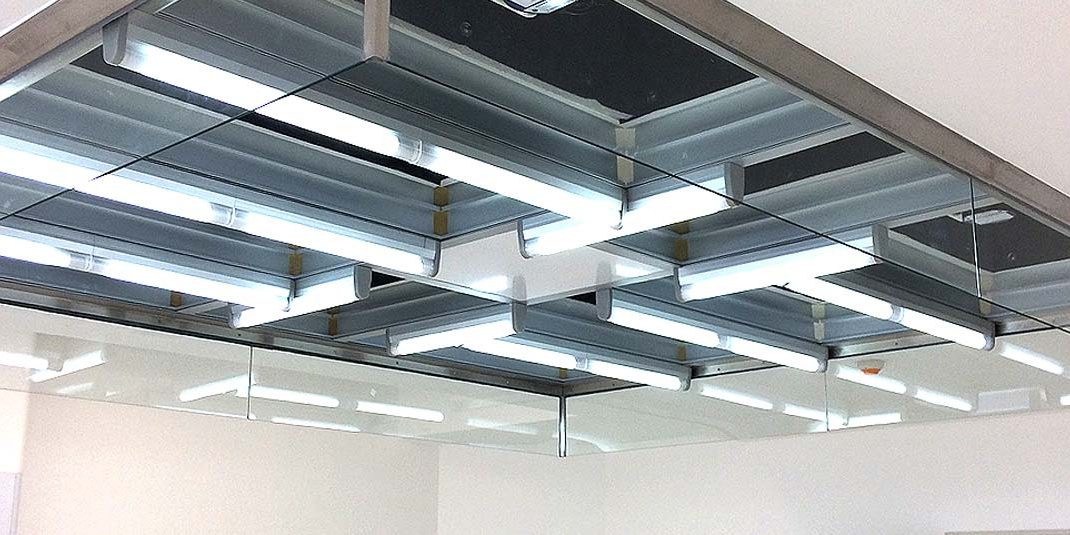
Type 3: Systems with HEPA Filter Lining in Fan Filter Units
Features
- Filter Location: HEPA filters mounted on structure with individual fans.
- Air Distribution: Each filter has a fan to individually adjust the air flow.
- Air Return: Allows partial recirculation of internal air.
Advantages and Limitations
- Advantages:
- Lower risk of air contamination.
- Precise control of air flow.
- Reduction in AHU size, resulting in lower energy consumption.
- Limitations:
- Concern about the noise level of the fans.
- Space required for installation can be a challenge.
Rules and Regulations
Norma Ashrae 170:2017
The Ashrae 170:2017 standard highlights the need for a unidirectional flow over the surgical table, with an air flow rate between 127 and 178 l/s per m². The flow must cover both the patient and the surgical team, exceeding at least 305 mm on each side of the table. And, the air returns must be positioned close to the floor, with a maximum height of 203 mm, and there may be additional returns on the sides.
DIN 1946-4:2018 standard
This standard establishes that the noise level in operating rooms must be below 48 dB(A), measured at 1,8 meters from the floor. It also establishes safety and performance tests, such as checking for leaks in the filtration system and airflow consistency.
Frequently Asked Questions (FAQs)
1. What is a unidirectional flow system?
A unidirectional flow system is a ventilation system that provides filtered air in a continuous and controlled manner to critical areas, removing contaminating particles and maintaining the sterility of the environment.
2. What are the main types of unidirectional flow systems?
The main types are:
- Perforated plate diffusers with or without side air curtains.
- Systems with filter lining – HEPA filters.
- Systems with HEPA filter lining in fan filter units.
3. What are the advantages of HEPA filter lining systems in fan filter units?
The main advantages include lower risk of atmospheric contamination, precise control of the ventilation flow, and the possibility of recirculating part of the internal breathing, resulting in lower energy consumption.
4. What are the standards that regulate unidirectional flows in operating rooms?
The main standards are Ashrae 170:2017 and DIN 1946-4:2018, which establish requirements for air flow, flow coverage, noise levels and performance tests.
Conclusion
The application of unidirectional flow systems in clean rooms, especially in surgical centers, is crucial to ensure a sterile and safe environment. Understanding the different types of systems, their advantages and limitations is essential. This way, engineers and healthcare professionals can choose and implement the best solution for their needs, following regulatory standards. The constant evolution of these technologies promises continuous improvements in the efficiency and safety of hospital environments.