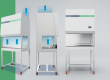
Technological advancements in the industrial, pharmaceutical, and electronics sectors have raised the bar for purity in production processes. The miniature size of the components handled today, whether it's an injectable drug or a semiconductor chip, means that even the smallest presence of external contaminants is not just an operational failure, but a quality risk that compromises the entire production batch. Managing environments where cross-contamination is unavoidable requires more than just good practices; it demands highly controlled and validated environmental engineering solutions.
In this scenario of increasing technical rigor, production processes need to be shielded against unpredictable environmental variables, such as atmospheric dust, suspended microorganisms, or foreign particles. Maintaining environmental integrity is therefore a critical component of risk management and regulatory compliance (such as Good Manufacturing Practices – GMP). The focus cannot simply be on production; it must be on production with proof of environmental control at every stage.
This is where the need for highly predictable airflow systems becomes evident. The ability to create a controlled and stable microclimate on the workbench is the competitive differentiator for cutting-edge industries.
Table of contents
What is an industrial laminar flow hood?
In the modern production environment, where the purity of the environment and components is not only desirable but mandatory for operational success, environmental control represents a critical pillar of any high-tech process. Maintaining an environment free of suspended particles, dust, and biological contaminants requires highly specialized engineering solutions. It is in this context that the industrial laminar flow cabinet establishes itself as a fundamental tool.

Conceptually, a laminar flow cabinet is a controlled, pressurized system designed to ensure that air circulates in a uniform and predictable pattern over the work area. This non-turbulent (laminar) air movement drastically minimizes the deposition of suspended particles onto the materials, equipment, or biological samples being handled.
For those operating in the industrial sector, whether in precision electronics, the pharmaceutical industry, or research laboratories, ensuring a specific level of environmental cleanliness is what defines the quality of the final product and the safety of the process . The primary function of an industrial laminar flow cabinet is, therefore, to protect both the internal environment and the materials being handled from external contaminants.
Physical principles and technical operation
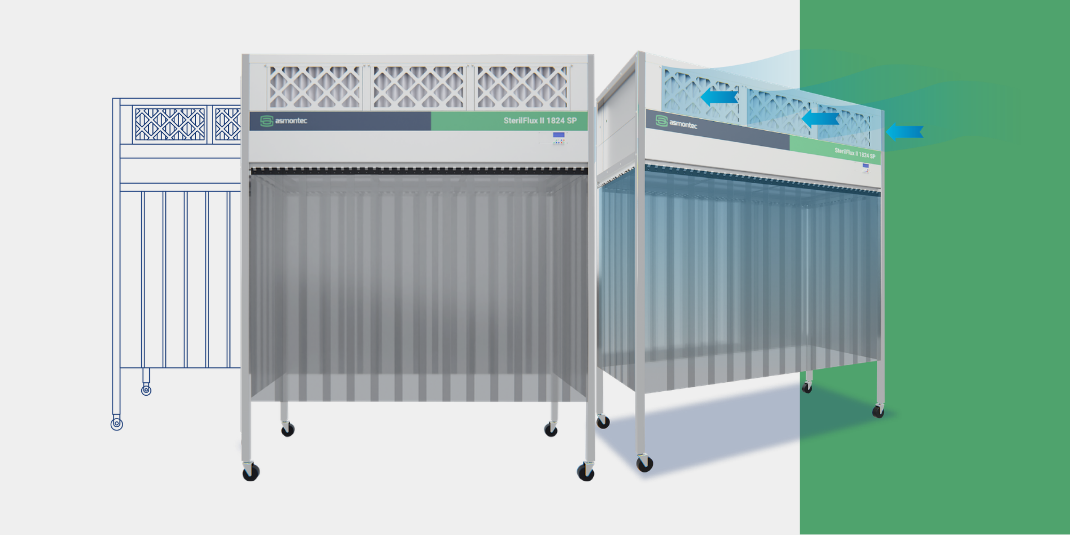
The Modular Unidirectional Airflow system is a protective device that ensures an ultra-clean air environment, free of contaminant particles. Through HEPA filters, it provides a vertical (laminar) unidirectional airflow over the work area, protecting the product during critical handling.
To create this controlled environment, the system operates in three stages:
- Advanced filtering: Outside air is drawn in and passes through multiple stages of filtration. The most critical are the... HEPA filters (High Efficiency Particulate Air) or ULPA (Ultra Low Penetration Air), which retain a very high percentage of particles, from visible dust to microorganisms and aerosols.
- Differential pressurization: The system operates with positive pressure relative to the surrounding environment. Thus, if there is any small opening or leak in the cabin, the air flows out with enough force to prevent the entry of external contaminants, such as dust and pollutants.
- Standardization and distribution: The filters generate a large volume of clean air, distributed at a constant speed across the entire internal workbench. This layer of air passes through the handling area without turbulence and carries away suspended particles before they can settle on the items of interest.
The precision of these steps requires continuous monitoring of flow velocity and flow rate, differential pressure, and filter integrity. Any deviation in these parameters compromises the equipment's operation and, consequently, the expected process result.
Main advantages of Modular Vertical Unidirectional Flow
Modular Unidirectional Flow Cabinets are essential for ensuring an ultra-clean and contamination-free work environment in a variety of applications.
- Protection against contamination It preserves the integrity of sensitive products, such as medicines and electronic components.
- Product quality improvement: It reduces the incidence of defects caused by particles, increasing reliability.
- Safe work environment: It protects the product against external contamination during handling.
- Increased production efficiency: It minimizes the need for rework and the disposal of contaminated products.
Technical applications in modern industry
The field of application for industrial laminar flow cabinets is vast, as they serve any sector where environmental contamination represents a critical risk to the product or process. The nature of the control is not limited to sterilization alone, but also includes granulometric and biological control.
Pharmaceutical and Biotechnology Laboratories
This is perhaps the best-known application of this equipment. In the production of sterile medicines (such as injectables or vaccines), failure to control particles can lead to bacterial contamination, resulting in lost batches and risks to public health. The cabinets are used in aseptic zones for handling culture media, diluting expensive reagents, and final assembly of pharmaceutical products.
Electronics and Aerospace Industry
When working with semiconductors or highly sensitive electronic components (such as OLED displays or integrated circuit boards), particle control is vital. A single strand of dust can cause a short circuit, reduce the efficiency of the optical material, or compromise component performance. The industrial laminar flow cabinet ensures that assembly and inspection operations occur under clean conditions controlled by strict standards.
Cosmetology and Optics
Even sectors that seem less “critical” than pharmaceuticals, such as fine cosmetics or the optical industry, benefit immensely from this control. The formulation of creams and makeup requires an environment free of microorganisms to ensure consumer safety. Similarly, sensitive optical lenses require handling in areas that prevent the accumulation of minute dust particles, which can compromise the visual performance of the final product.
Operational characteristics and sizing of the Modular Unidirectional Flow
Choosing the right equipment goes beyond just function: it depends on strict physical parameters, such as dimensions, flow type, and operational capacity.
Structural dimensioning and typologies
There are different configurations to meet the needs of each industrial operation:
- Modular cabins: They offer great flexibility, as the equipment is sized in smaller modules that can be combined according to the available workspace or increased production demand.
- Fixed structures: They are ideal for environments where dimensions are already defined and there are no plans to change them. They provide robust integration and, often, a more harmonious blend with the existing factory environment.
When sizing the equipment, it is necessary to consider the total usable area (the work surface) and the flow rate required to maintain a constant flow over it, ensuring that the minimum air velocity limits are respected at all points.
Technical characteristics that ensure the quality of the Modular Unidirectional Flow.
Sterility guaranteed: Creates a work environment free from particle contamination.
Sample and product protection: Preserves the integrity of sensitive materials, preventing losses and failures.
Air quality control: Provides an ultra-filtered airflow, essential for critical processes.
Maintenance, limitations, and alternative solutions.
To operate any critical equipment at a high standard, it is essential to understand both the system's requirements and limitations. Preventive maintenance cannot be neglected. The lifespan of a HEPA filter is determined by the contaminant load and operating hours; scheduled replacement or replacement based on pressure drop monitoring ensures effective laminar flow.
When should you consider other solutions?
Technical experience shows that, as with any engineering solution, there are drawbacks. It's possible that an environment may not strictly require the full laminar flow pattern. For example:
- Localized Control: If it is only necessary to control contamination at very specific and restricted points (such as a smaller workbench), smaller cabinet solutions may be more efficient and economical than a large industrial laminar flow cabinet.
- Nature of the Contaminant: In scenarios where the primary risk is exposure to hazardous chemical agents, fume hoods (chemical hoods) are necessary because they primarily deal with vapors and gases, not just particles.
A thorough understanding of operational needs allows the consultant to identify whether full laminar flow or an auxiliary system is most suitable, optimizing costs without compromising process quality. Continuous pressure monitoring (either by differential sensors or pressure gauges) and regular filter inspection are essential practices for maintaining nominal performance.
The importance of a specialized partner
Acquiring an industrial laminar flow cabinet is an investment in quality control, traceability, and product safety. The value of the equipment transcends the steel and filters; it lies in the capability it provides to your production: the guarantee of environmental purity under extreme operating conditions.
That's why the specification process must be consultative. A technical dialogue is necessary to understand if laminar flow is the most efficient solution, if a modular system better suits the future growth of the plant, and what the exact level of positive pressure required by your specific sector is. An experienced partner doesn't just sell equipment; they develop environmental protocols that ensure business continuity in critical environments.
Contact our technical team and find out how we can help your company.
FAQ
The main difference lies in the contaminant each aims to control. A laminar flow hood primarily deals with airborne particles, maintaining a clean work area through controlled air movement. A fume hood, on the other hand, is designed to handle hazardous chemical vapors, drawing them in and exhausting them out of the environment, without necessarily creating a laminar flow pattern over the reaction point.
HEPA filtration requires the constant pumping of large volumes of air under positive pressure, which naturally increases energy consumption compared to natural ventilation. However, modern systems are designed to optimize this use, utilizing intelligent flow monitoring and integrating with efficient HVAC systems, ensuring that the operating cost is justified by the added value of the final product quality.
Yes, it's possible. Often, the need for an upgrade doesn't require a complete replacement. By using modules or adapting the interface with existing systems (as seen in modular solutions), it's possible to adjust the usable area and recalibrate the differential pressure to meet new production demands without drastically interrupting operations.
Yes, maintenance is rigorous and mandatory. It includes not only the periodic replacement of filters (HEPA/ULPA), but also regular checks of differential pressure sensors, airflow balancing, and internal cleaning. A detailed preventive maintenance program ensures that the equipment maintains its purity level in accordance with the technical standards required by the industry.
Temperature and humidity control are critical factors for optimal operation. Extreme fluctuations can affect air density, altering flow patterns and compromising the positive pressure established by the equipment. Therefore, installation should take place in an environment with stable and controlled climate control.